
We are often asked about blockages in Moat Brook. The series of pictures below explain why blockages are a good thing for the brook and should be left alone.

In the 1800s the Moat Brook brook was straightened out by the land owner and this created many problems. When water courses are straightened, flow velocity and water depth become uniform, which leads to silting up and widening of the brook, as can be seen above. This means less diversity of habitats and during high rainfall events, the water runs straight through the area unimpeded, which can lead to flooding of towns and cities further downstream.
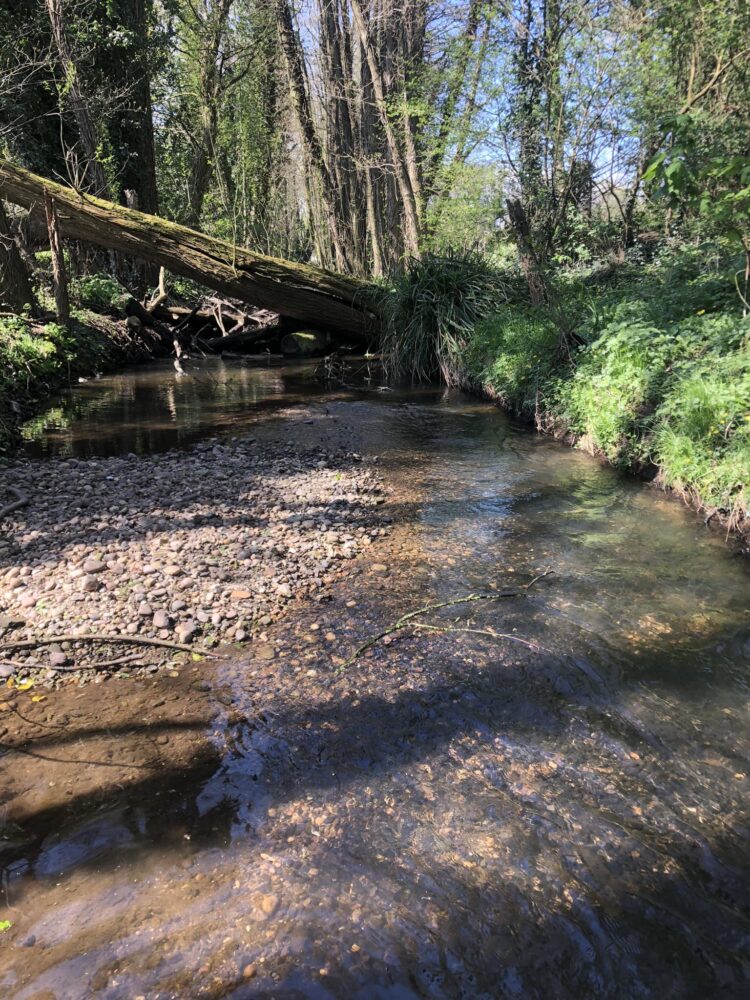
Natural blockages are sometimes known as leaky dams, such as the one pictured above. These hold back, or store, a significant amount of water. The water then flows around and beneath the blockage, creating new kinks in the banks, and gouging out the river bed depositing large stones and gravel downstream. Over these gravels, known as riffles, the water is oxygenated and the velocity increases which gives the water more energy. The gravels also separate in size and into the smaller gravel deposits, known as redds, fish such as brown trout lay their eggs. These different habitats also attract different invertebrates, which are food for the fish.
Leaky dams also play a very important role during high rainfall in that they ‘slow the flow’ of the water so it doesn’t all end up downstream very quickly. In the past during high rainfall events, where the rivers converge such as in Stafford on the River Sow, there has been serious flooding of the town. This is a consequence of bad river management and ‘tidying up’ of the tributaries upstream of the Sow. By trapping the water in Moat Brook with our leaky dams, we are helping to alleviate flooding in Stafford and Stoke-on-Trent.

Here there are significant gravel deposits which contrast greatly with the silted river bed in the first picture.

Deep pools are also created close to the blockages, where the water has gouged out the river bed. These deep areas are cooler in temperature and provide shelter for fish and other aquatic creatures such as white-clawed crayfish. Different invertebrates, which are also food for fish, colonise these pools as the woody debris is a source of food for them.
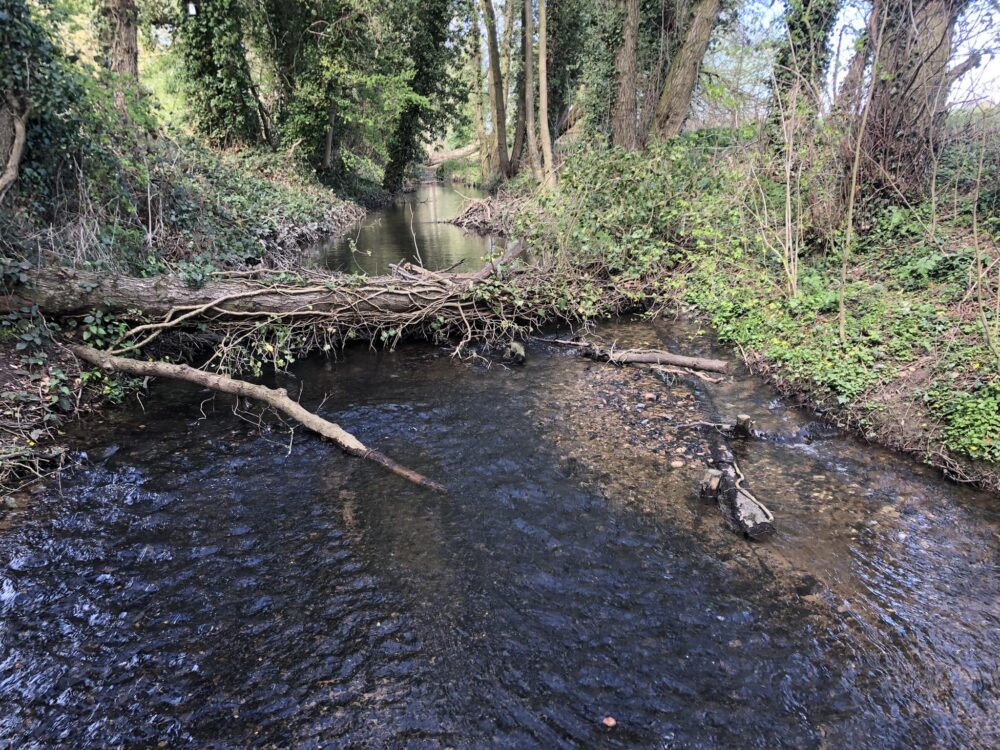
Above you can see some of the restoration work we carried out a couple of years ago, as well as natural debris which has fallen into the brook. Fresh gravel deposits are forming on the right and water velocity is increasing as a consequence. The water flow on the left is slower and all these different conditions in this stretch of the brook are favoured by different invertebrates, thus adding to the biodiversity of the brook.

Further natural falls into the brook have created a wealth of habitats. In the section of the brook above there are some very deep pools as well as shallow riffles. Not surprisingly, this is a favourite fishing spot for our kingfishers, who are regularly seen here. These trees also provide a bridge across the brook for small mammals, allowing them to colonise new areas along the river bank and so increasing biodiversity as well as adding additional food sources for raptors such as kestrels and barn owls.

These blockages also trap litter, preventing it from flowing further downstream causing harm to wildlife and ultimately entering the seas. When it becomes trapped it allows us to pick out the litter easily.

So our leaky dams are proving a multitude of essential services not only to the aquatic life which lives in the Moat Brook but also the marine life in the North Sea and those who live further downstream near to the rivers Sow and Trent. So next time you see woody debris in the Moat Brook, please don’t pick it out, but leave it where it is and remember how important it is to be left alone. You’re very welcome to pick out the litter though – thank you.
